Designing accessibility and motion into a healthcare app built to reach 100 million lives.
As Experience Design Lead, I owned accessibility and motion design across the entire Bupa Blua app — an iOS and Android product built to anchor Bupa's global ambition of 100 million customers. From WCAG 2.2 AA documentation to After Effects–to–Lottie animation pipelines, I was the connective tissue across four journey teams spanning Australian design and Indian development.
Healthcare, at global scale, held to one accessibility standard.
Bupa Blua was built as an entry point into Bupa's global ambition — reaching 100 million customers through the app and Bupa's existing services. For a healthcare product, that scale raises the stakes on accessibility considerably: the population using it skews older, less able-bodied, and more reliant on assistive technology than the average consumer app audience. Accessibility couldn't be treated as a compliance checkbox added at the end.
The app was being built simultaneously by four separate journey teams, with designers based in Australia and development teams based in India working across overlapping time zones. Without a single, consistently applied standard for accessibility and motion, each team would have interpreted requirements differently — producing an app that felt, and behaved, inconsistently from one journey to the next.
Two mandates that ran horizontally across every journey.
Rather than owning a single journey vertically, I held two responsibilities that cut across all four: accessibility and motion. That meant auditing, documenting and validating continuously as features shipped — not reviewing after the fact — and being the one designer every team could turn to for a definitive answer on either discipline.
WCAG 2.2 AA, documented once, validated everywhere.
I wrote detailed accessibility documentation covering component behavior, focus order and screen-reader expectations, then worked directly alongside accessibility specialists to close gaps before anything reached build. A compliant spec means nothing if VoiceOver and TalkBack interpret it differently, so every component's behavior was validated on both iOS and Android before being signed off.
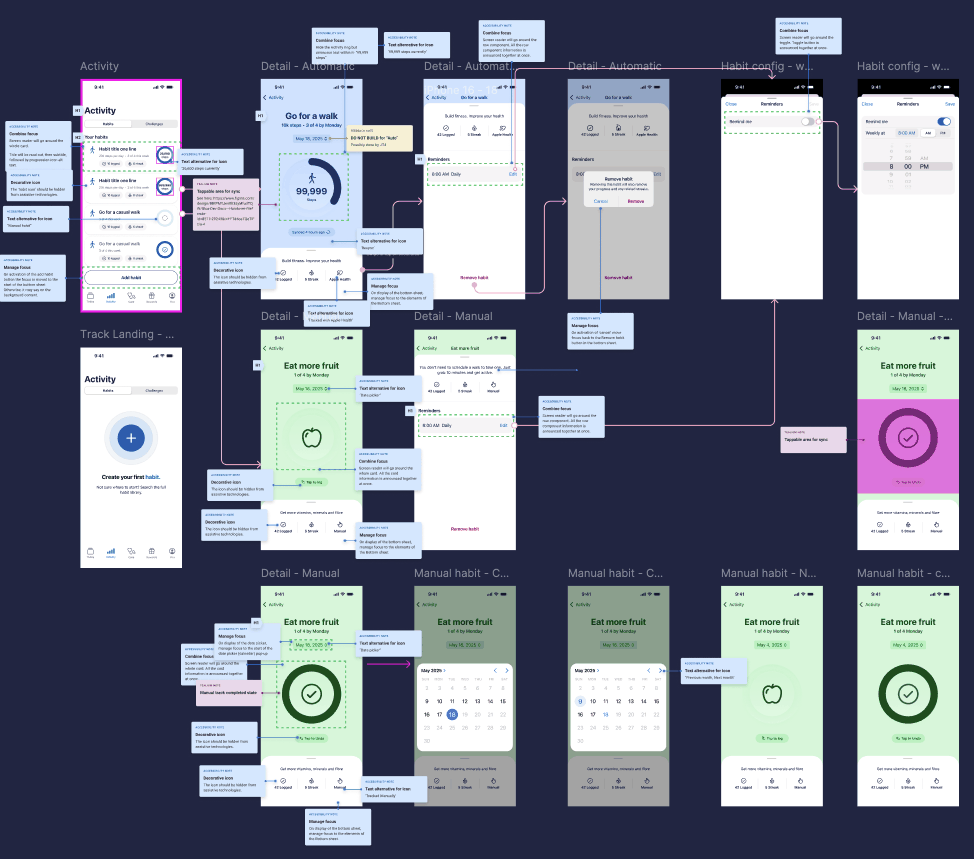
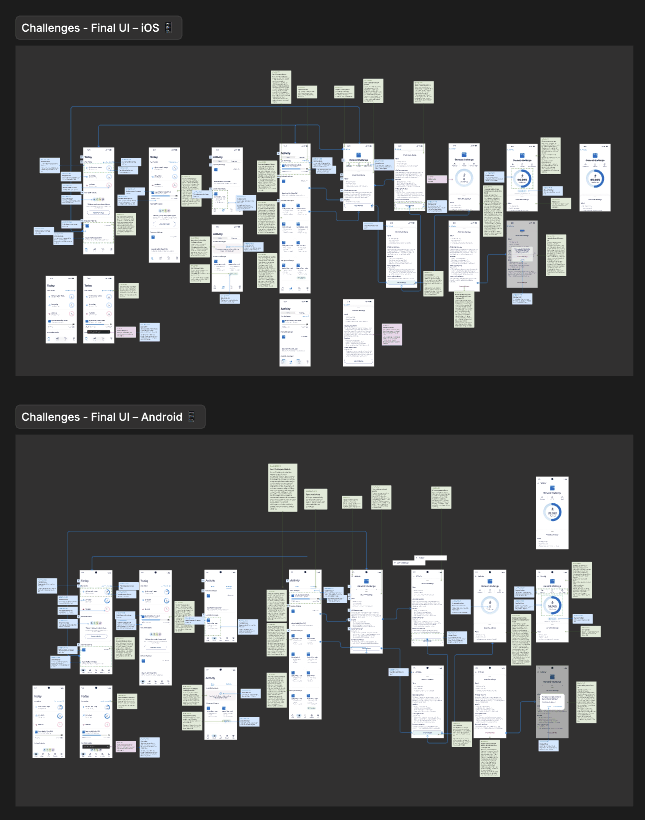
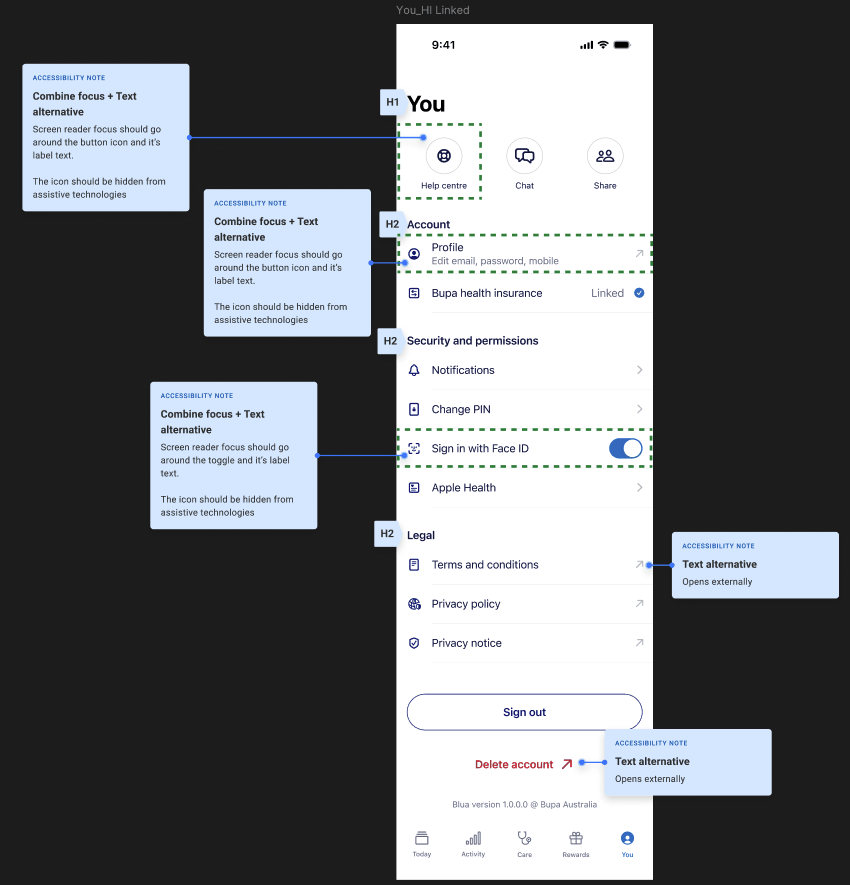
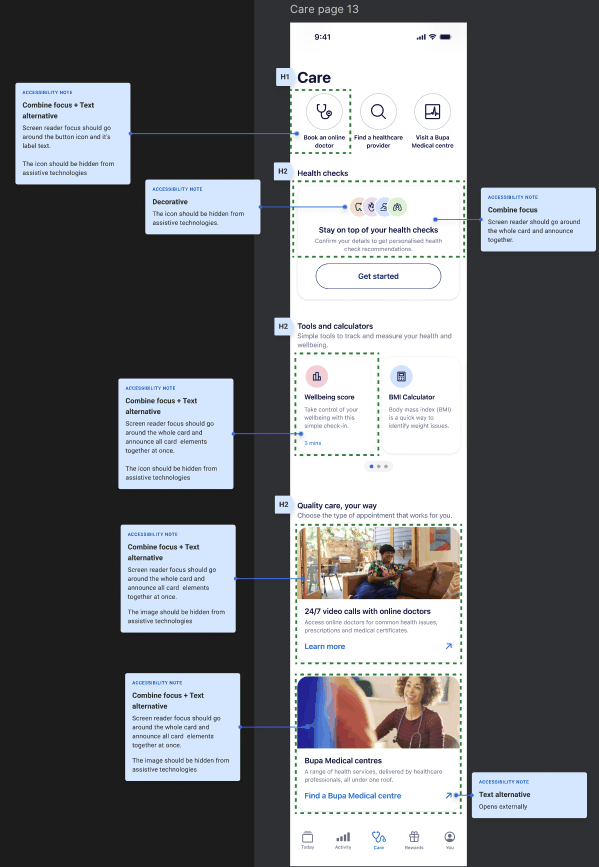
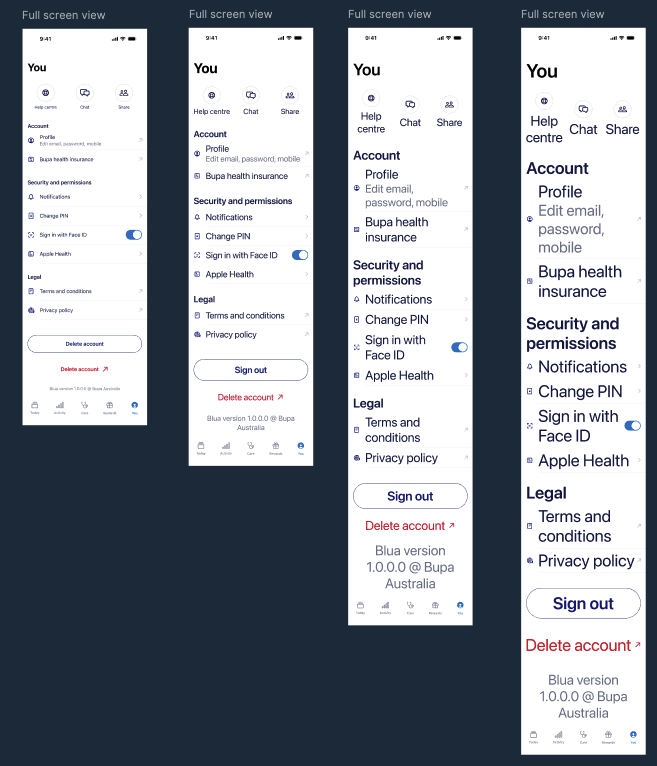
Detailed documentation — type scale, spacing, component states and focus behavior — meant developers and PMs across four teams and two countries could reference one standard rather than four interpretations of it. Structured knowledge-transfer sessions reinforced how to read and apply it correctly.
Motion with a job to do.
I introduced an After Effects–to–Lottie pipeline that didn't exist on the product before, replacing static loaders and abrupt transitions with lightweight, purposeful animation. Every animation was scoped to a job — confirm a success, hold attention through a wait, celebrate a milestone — never decoration for its own sake.
The POC between two continents.
I served as the single point of contact across all four journey teams, coordinating Australia-based designers with India-based development teams through overlapping AU–IN working hours. When design and build diverged, I owned the triage — deciding what shipped, what got fixed, and what needed re-spec — so discrepancies never sat unresolved between two time zones.
Alongside that, I ran structured knowledge-transfer sessions for developers and PMs on accessibility requirements and documentation standards, and mentored designers on applying the same standard consistently across their journeys. The goal was a team that understood the "why" behind each requirement, not just a checklist to follow.
One standard, four teams, two platforms, one global launch.
Blua launched in late 2025 as Bupa's step toward reaching 100 million customers worldwide — accessible and animated to the same standard across every journey, on both iOS and Android.