From 53 AI opportunities to a working Agentic prototype in a 2-week sprint.
Led UX discovery and experience exploration for a leading B2B roofing supply enterprise — auditing an existing ecommerce ecosystem, mapping the Agentic AI opportunity space, and shipping an end-to-end prototype that embedded intelligent workflow assistance directly into the customer dashboard.
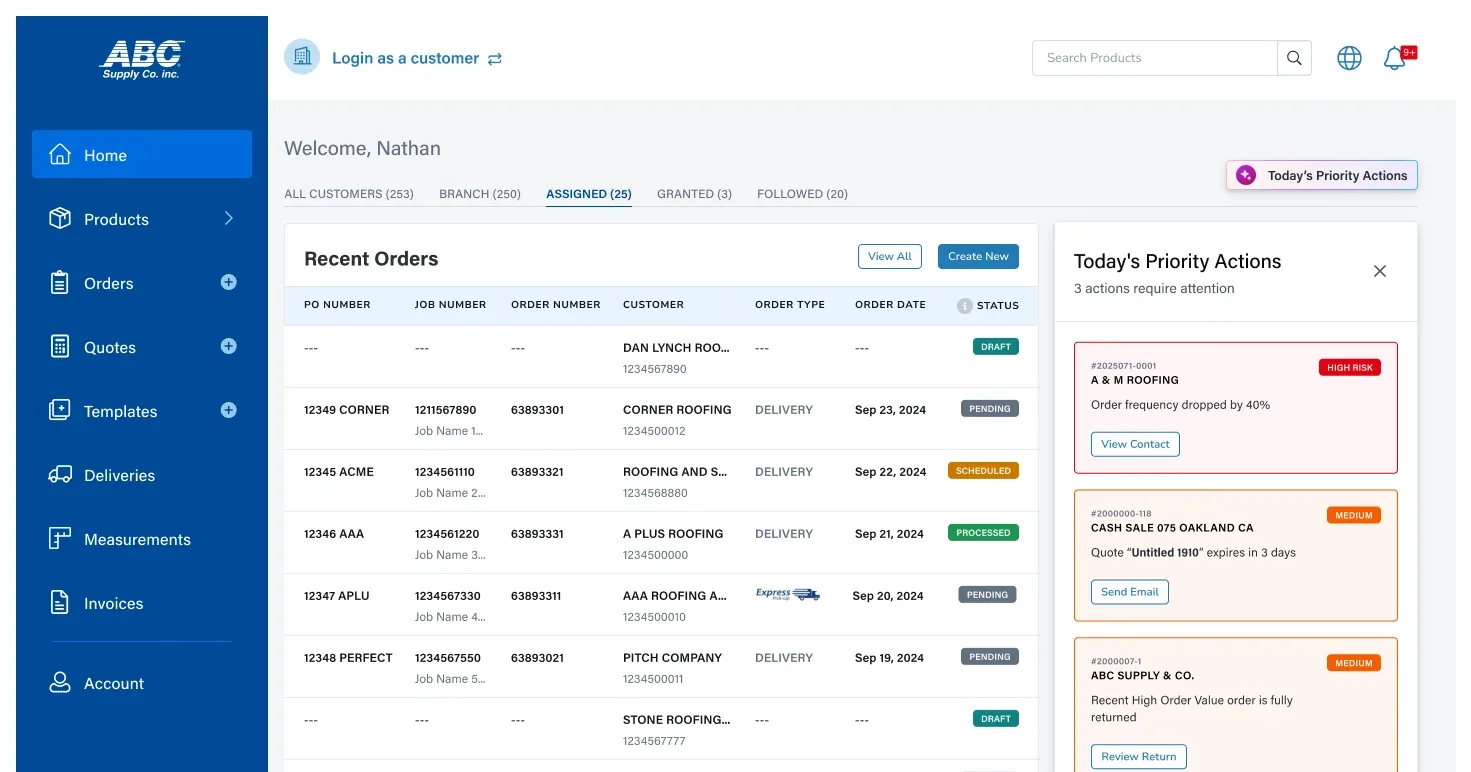
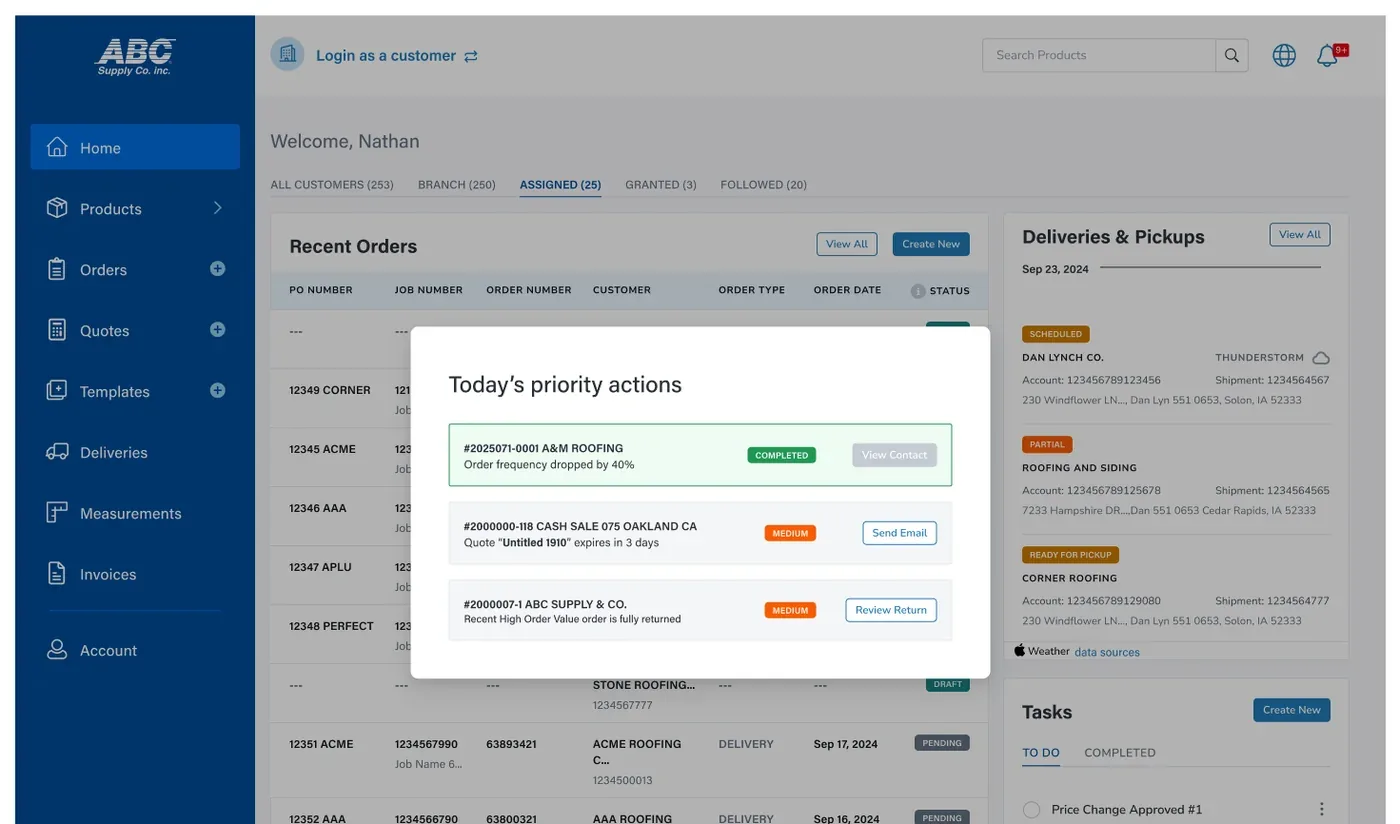
Final direction — a persistent, docked "Today's Priority Actions" panel embedded in the dashboard.
A mature B2B ecommerce ecosystem, ready for its next layer.
ABC Supply's digital storefront already served customers, associates and vendors across desktop, tablet and mobile. The engagement had two parallel tracks: scalable UX enhancements to the existing ecommerce experience — improving usability, workflow clarity and enterprise user efficiency — and a forward-looking exploration of where Agentic AI could meaningfully change how contractors, branch associates and vendors get work done.
Over three months I worked cross-functionally with Product Owners, an Associate Director of Product Management, and North America-based Design Leadership to move from broad opportunity mapping to a validated, working prototype.
Where B2B AI actually lives today — and where it doesn't.
Before proposing anything new, I benchmarked how AI shows up across six B2B and adjacent platforms — Grainger, Wayfair, Ferguson Enterprises, MSC Industrial Direct, Salesforce Agentforce and ServiceNow Now Assist — scored across five dimensions: category, placement, persona, contextual awareness and proactivity.
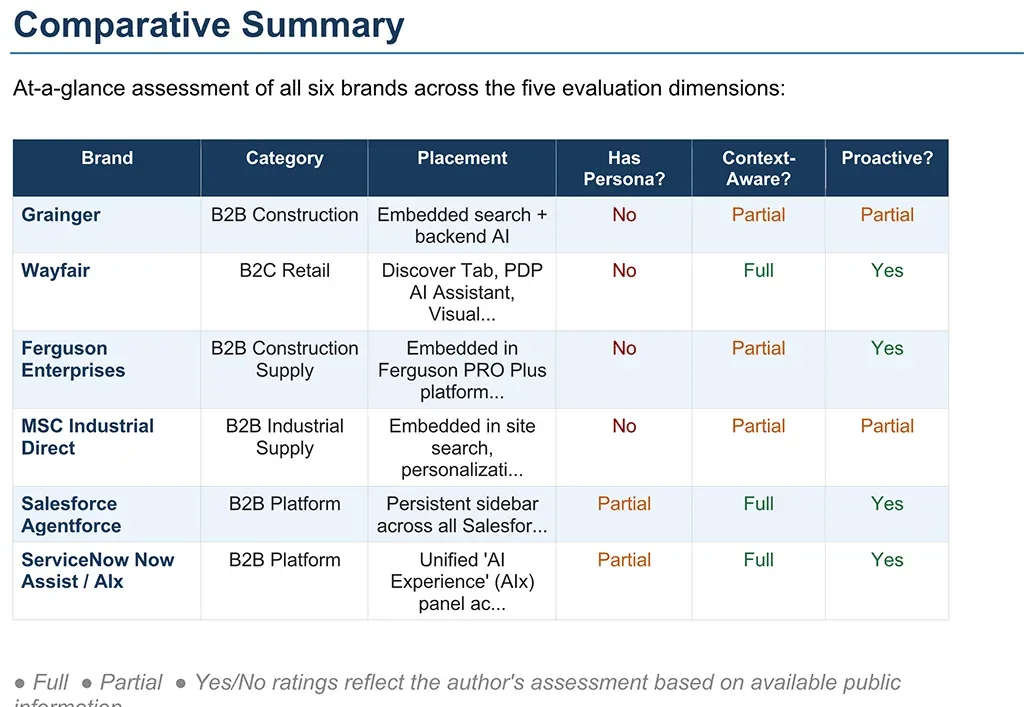
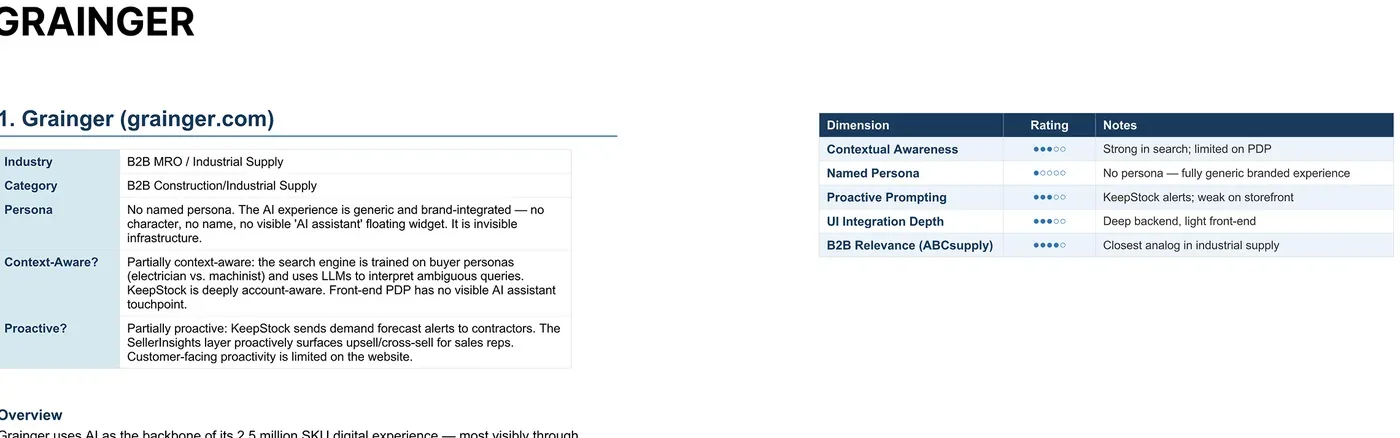
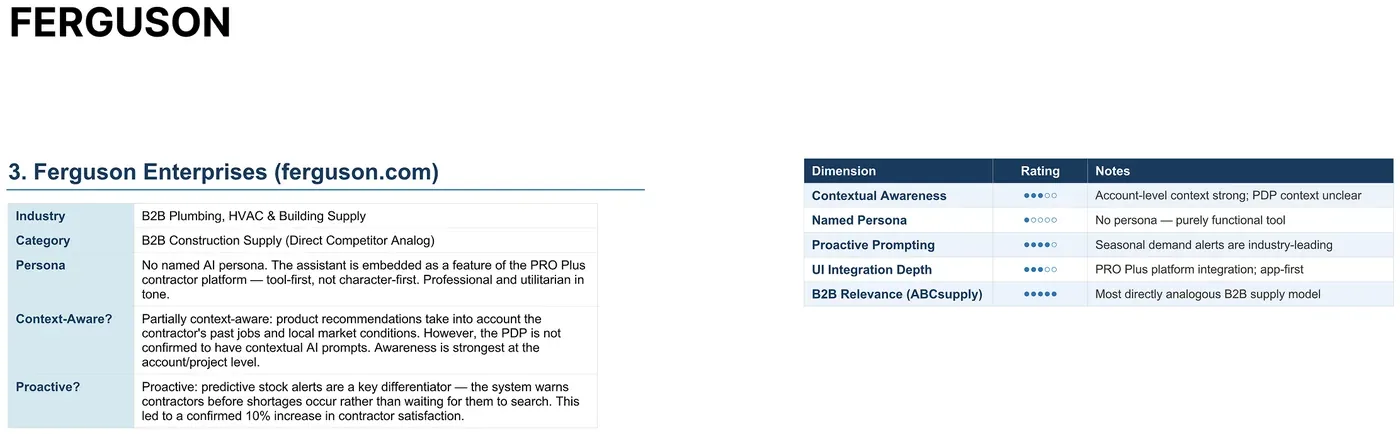
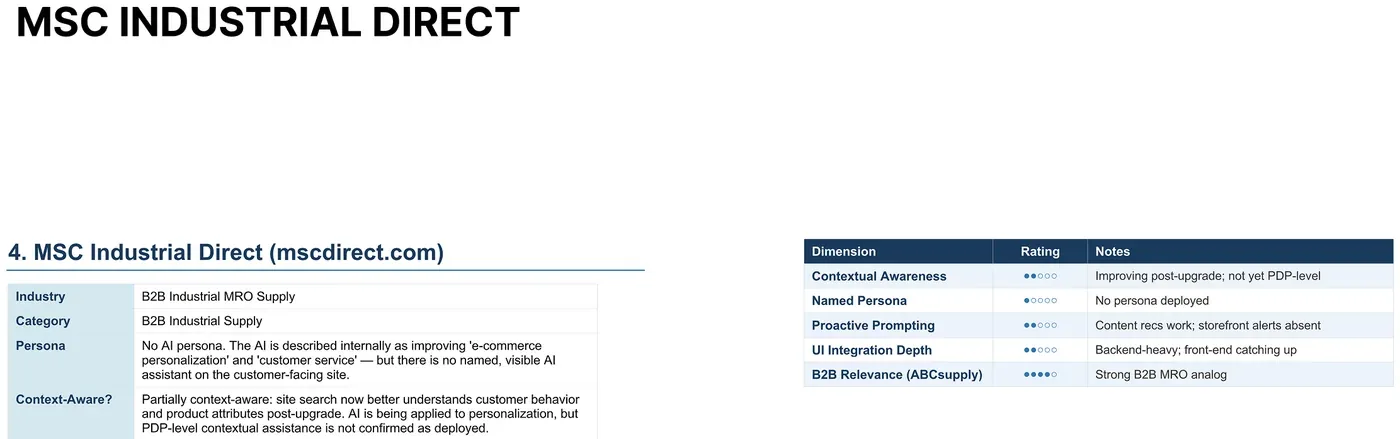
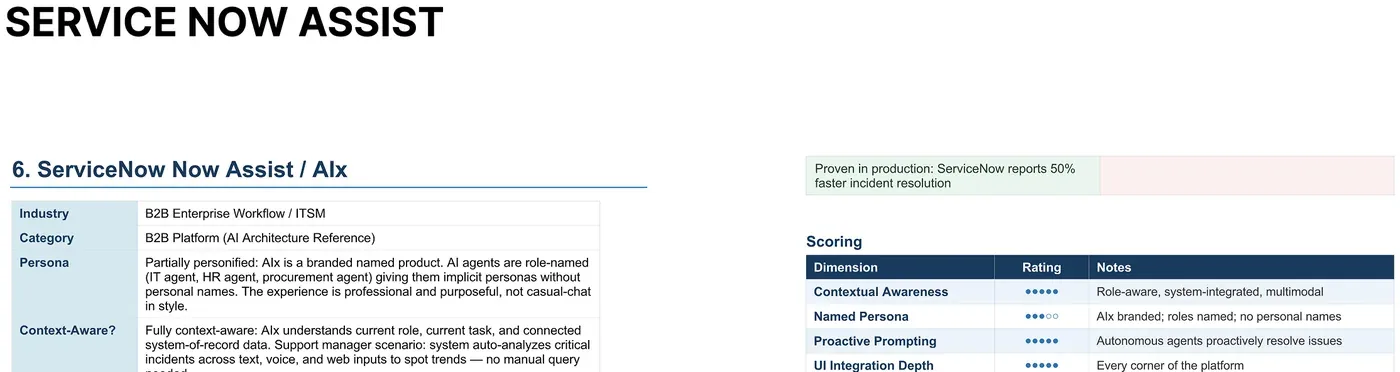
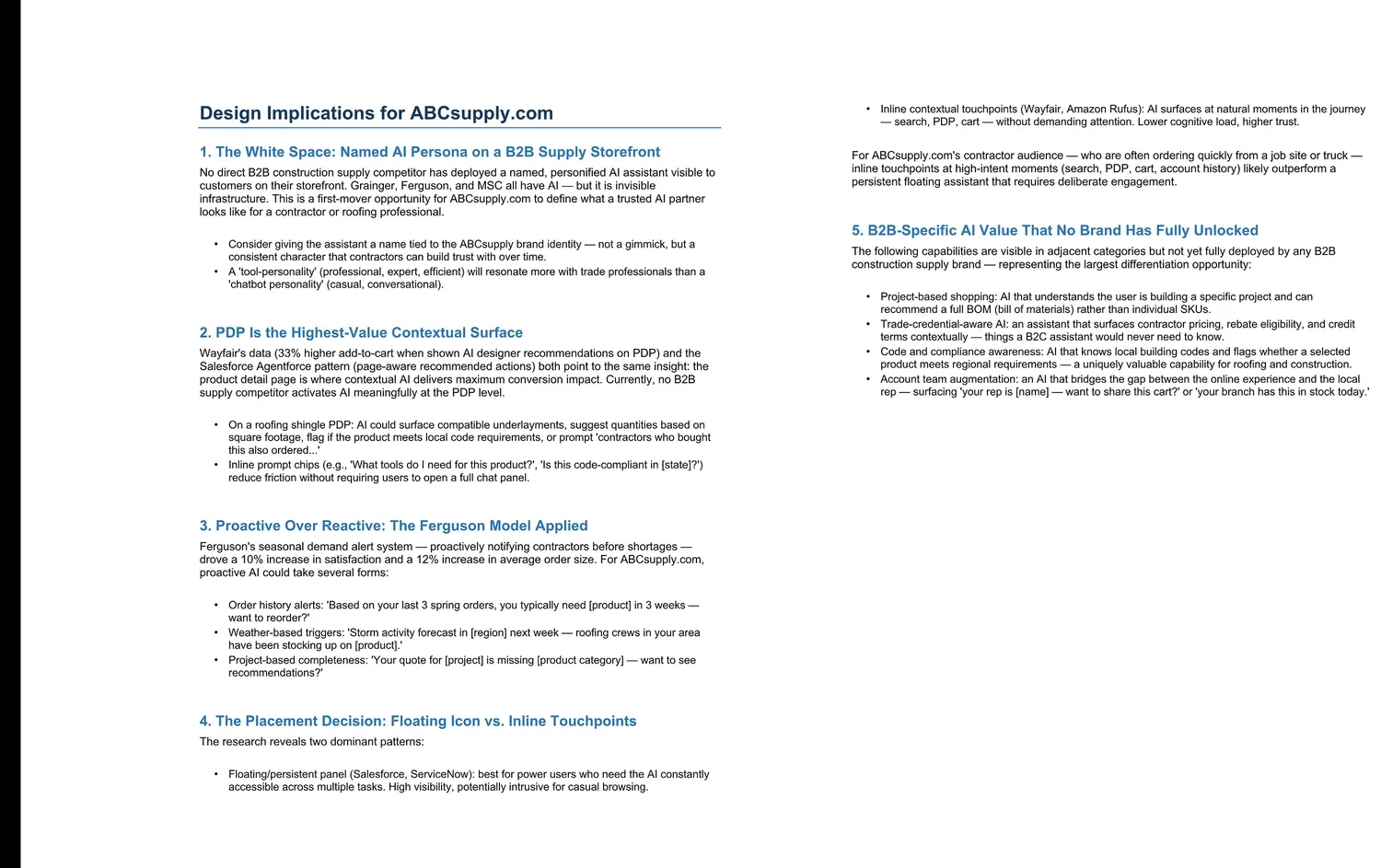
The synthesis surfaced a clear white space: no direct B2B construction-supply competitor had shipped a named, customer-facing AI persona, and none activated AI meaningfully at the product-detail level — despite Wayfair reporting a 33% lift in add-to-cart when AI-driven recommendations appeared there. Those findings, plus the "floating icon vs. inline touchpoint" placement question, became the design brief for ABC Supply.
53 possibilities, narrowed to 5 that mattered.
Working alongside Product and Design Leadership, I helped define and prioritize 53 potential AI/Agentic experience opportunities spanning the full ABC Supply ecosystem, then stack-ranked them against customer, associate and vendor pain points to arrive at 5 high-impact, enterprise-ready use cases.
An end-to-end Agentic AI prototype, built in 2 weeks.
With direction validated, I conceptualized and delivered a working prototype within an accelerated 2-week sprint — integrating intelligent workflow assistance directly into the dashboard rather than isolating it in a separate chat experience. Each use case below was built as a full, click-through flow and reviewed in fast-paced stakeholder workshops.
The flow surfaces job-site photos, product matches and pricing context inline as a quote is built — replacing manual lookups with assistance embedded directly in the task.

An assistant panel walks the approver through flagged line items conversationally, explaining why an anomaly was raised and what action resolves it — keeping approval fast without losing scrutiny.

Rather than waiting for a customer to ask, the system pushes proactive, contextual alerts — echoing the "proactive over reactive" pattern validated in the Ferguson research — directly into the associate's daily workflow.

Surfacing AI without disrupting the work underneath.
The research raised a specific placement question: a floating, persistent panel reads as high-visibility but can feel intrusive during casual browsing, while an inline or modal touchpoint is lower-friction but easier to miss. I prototyped both directions for the "Today's Priority Actions" surface and tested them against ABC Supply's actual working screens.
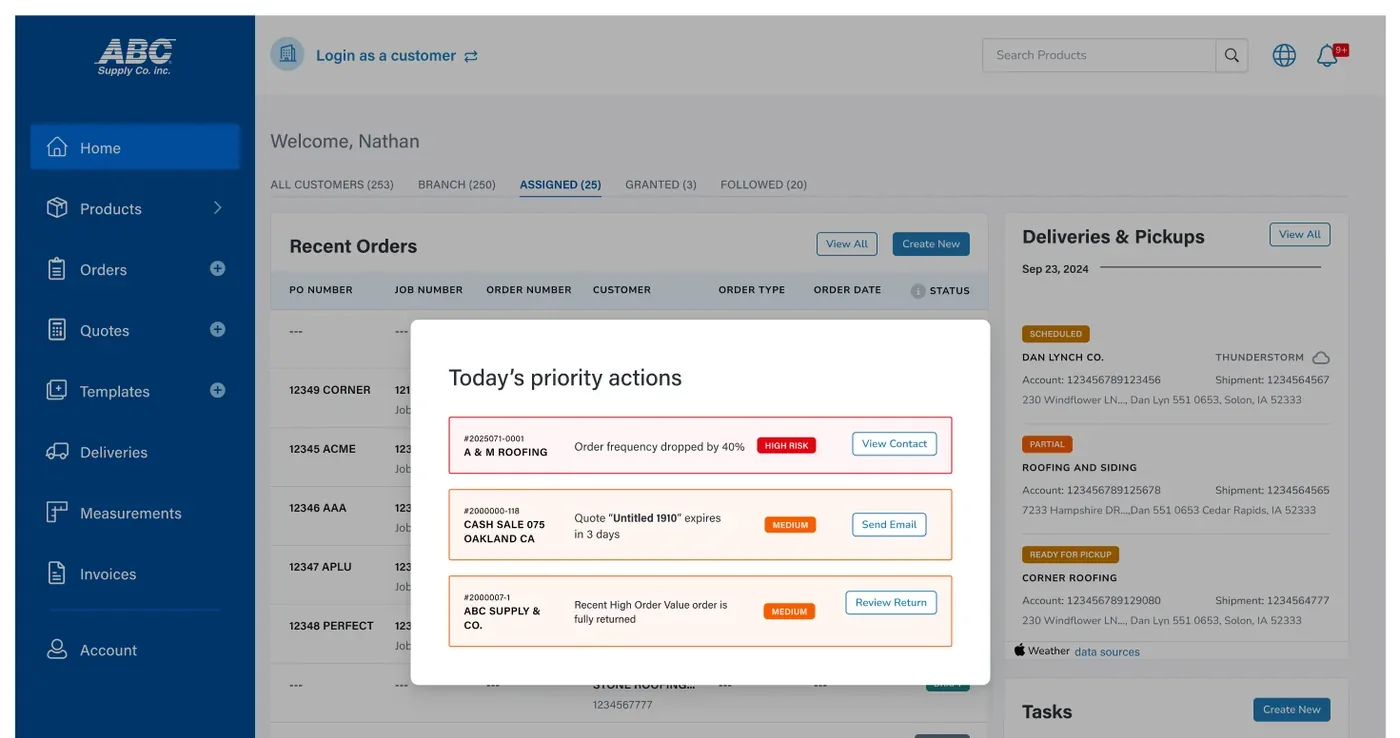
The docked panel won out — it kept priority actions constantly visible for the power users (branch associates, account managers) who rely on it most, without blocking the order table underneath. I also explored the resolved/completed state so the panel reads as a living to-do list rather than a static alert feed.
A validated direction, delivered at pace.
The engagement moved from open-ended discovery to a client-reviewed, working prototype in three months — with the AI concept itself proven end-to-end in two weeks.